Hawaii Volcanoes National Park entrance fee explained: pass types, what each covers, when an annual or America the Beautiful pass pays off, and tour entry.
What the Park Entrance Fee Covers
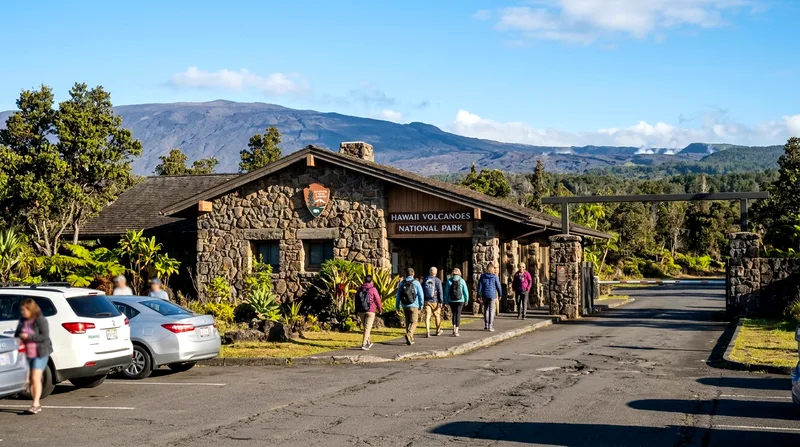
Every visitor driving, riding, or walking into Hawaiʻi Volcanoes National Park pays an entrance fee at the gate on Highway 11, and that single payment is really what unlocks the whole park for a set number of days — not just the summit area around Kīlauea. The National Park Service sets this fee, and it's the same structure used at most large US national parks: a per-vehicle rate that covers everyone inside the car, plus separate rates for motorcycles and individual walk-in or bike-in visitors.
Don't assume the fee buys you a guided experience or reserved entry to a specific trail. It doesn't. It's strictly admission — access to the road network, the Crater Rim Drive overlooks, Chain of Craters Road, Devastation Trail, and ranger-staffed visitor centers. Camping, cabin rentals at Nāmakanipaio, and backcountry permits are billed separately on top of the entrance fee.
What is included and excluded
The fee covers unlimited entries and exits during its validity window, access to all public roads and maintained trails, the Kīlauea Visitor Center, and ranger talks when scheduled. It does not cover camping fees, the historic Volcano House hotel, or lodging at Kilauea Military Camp, which is a separate recreation facility primarily for military-affiliated guests and has its own booking system entirely outside the NPS fee structure. Guided tours, helicopter flights, and lava-viewing boat trips (when conditions allow ocean entry viewing) are priced independently and almost never include the park fee unless the operator explicitly states it does.
Pass validity and park hours
A standard entrance receipt is valid for seven consecutive days from purchase, which matters if you're staying on the Big Island for a week and want to drive up for sunrise one day and a night walk to see the crater glow a few days later. Hawaiʻi Volcanoes National Park itself operates on a 24-hour schedule — the park doesn't close at dusk the way some mainland parks do, which is exactly why the after-dark Kīlauea overlook is such a draw. Visitor centers and the Jaggar Museum area have posted staffed hours that do change seasonally, so check the park's official hours page before planning a 2 a.m. drive up expecting a staffed kiosk.
Entrance Fee and Pass Options Compared
There are really three tiers of entry pricing at the gate, and picking the wrong one is the most common rookie mistake. Pay per vehicle, pay per motorcycle, or pay per person if you arrive on foot, by bicycle, or as a passenger dropped off by a tour shuttle that doesn't itself hold a commercial entry agreement.
A vehicle rate covers the driver and every passenger in that single, non-commercial car for the full seven-day window. That's the best deal for families or groups of friends splitting a rental car — one fee, everyone's in. Motorcyclists pay a lower per-bike rate that still covers one or two riders on that bike. Walk-ins, cyclists, and anyone arriving without a private vehicle pay an individual per-person rate, which is roughly half the motorcycle rate per the Park Service's published fee schedule — confirm the exact current figures on the NPS site before you go, since fees are periodically revised.
A private vehicle pass covers everyone in the car for seven days, while the America the Beautiful pass is the better buy for anyone visiting a second federal site within a year.
Hawaii Volcanoes National Park entrance fee and pass options compared
| Pass Type | Validity | Covers | Best For |
|---|---|---|---|
| Private vehicle entry | 7 days | Driver + all passengers in one non-commercial vehicle | Families, couples, groups sharing a rental car |
| Motorcycle entry | 7 days | One or two riders on one motorcycle | Motorcycle tourers |
| Individual/walk-in entry | 7 days | One person on foot, bike, or shuttle drop-off | Solo hikers, cyclists, cruise-day visitors without a car |
| Volcanoes NP annual pass | 12 months | Unlimited entry to this park only | Kona/Hilo residents, repeat seasonal visitors |
| America the Beautiful Pass | 12 months | Entry to Volcanoes NP, Haleakalā NP, and all other federal recreation fee sites nationwide | Multi-park trips, island-hoppers, frequent US park visitors |
Figures reflect typical, stable NPS fee structures; confirm exact current dollar amounts on nps.gov before you travel.
Vehicle, motorcycle and walk-in entry
If you're renting a car on the Big Island — which most visitors do, since public transit to the park is minimal — the vehicle rate is almost always your cheapest per-person option once you've got two or more people in the car. Solo travelers driving alone still pay the full vehicle rate, so if you're truly on your own and budget-conscious, compare that to the walk-in rate only if you're arriving by shuttle or rideshare drop-off, which is uncommon given the park's distance from Hilo and Kona hotel zones.
Park-specific and annual pass options
Beyond the single seven-day pass, Hawaiʻi Volcanoes National Park sells its own annual pass good for unlimited entry to that one park for twelve months from purchase — useful if you live on-island or you're a snowbird who returns every winter. It is not interchangeable with Haleakalā National Park on Maui; that park charges its own separate entrance fee and sells its own annual pass. If your Hawaii itinerary includes both parks, a single-park annual pass won't help you at the other gate.
Is an Annual or America the Beautiful Pass Worth It?
Here's the honest math: the America the Beautiful Pass costs roughly the same as two to three single-park vehicle entries, and it works at every federal fee-charging site in the country for a full year from the month of purchase — not just national parks, but also national monuments, wildlife refuges, and some Forest Service and BLM sites. If your trip includes both Hawaiʻi Volcanoes and Haleakalā, which is an extremely common Big Island–Maui combination, the pass pays for itself on the second gate alone.
Best value for island-hoppers and multi-park trips
World travelers stacking Hawaii onto a longer US trip — say, a stop at Grand Canyon or Yosemite later that year — get even more out of it, since the pass travels with you to any participating site nationwide. For a Hawaii-only itinerary, though, run the numbers first: if you're only setting foot in one park, one time, the single-park seven-day vehicle pass is cheaper and simpler. Don't buy the annual version "just in case" if you can't name the second park you'd use it at.
Discount and free-access eligibility
Active-duty military and dependents get a free annual version of the America the Beautiful Pass. US fourth-graders qualify for a free annual pass through the Every Kid Outdoors program. Seniors aged 62 and over (US citizens or permanent residents) can buy a lifetime senior pass at a steep one-time discount compared to the annual rate, or an annual senior pass at a lower price point — a genuinely good deal if you're a repeat visitor. Permanently disabled US residents get a free lifetime Access Pass. None of these discount passes apply to international visitors without US residency status, so European and other overseas travelers should budget for the standard annual or per-visit rate.
How Entry Works on a Guided Tour
Booking a van tour out of Kona or Hilo to see the volcano doesn't automatically mean you're covered at the gate — this trips up more visitors than you'd expect, especially those comparing Hawaii tours to all-inclusive-style packages they've used in Cancun or Puerto Rico, where entry fees are often bundled invisibly into the resort price. US national parks don't work that way by default.
Fee-inclusive versus fee-extra tours
Some commercial tour operators hold their own annual commercial use authorization with the park and build the entrance fee into your tour price — check the listing carefully, since reputable operators state this explicitly. Others expect every passenger to have their own valid pass or to chip in cash at the gate, which the guide handles on your behalf. If the tour description doesn't mention park entry at all, assume it's not included and ask before you book. When comparing current boat tours, lava-viewing excursions, and van tours before you book, look specifically for the phrase "entrance fee included" or "park fee not included" in the fine print — it's usually there if you scroll far enough.
Where and How to Buy Your Pass
Buying at the gate is still the simplest route for most visitors, and it's cash- and card-friendly at the Hawaiʻi Volcanoes entrance station.
Official channels: park gate and recreation.gov
Pay directly at the entrance station on Highway 11, or buy in advance through recreation.gov, the federal government's official booking platform, which also sells the America the Beautiful Pass online and ships a physical card. The park's own annual pass can be purchased at the entrance station or at the Kīlauea Visitor Center. Avoid third-party ticket resellers or unofficial-looking websites promising "skip the line" park passes — national parks in Hawaii don't require timed-entry tickets the way some mainland parks (like Arches or Zion) now do, so there's no legitimate line to skip, and any site charging a markup for a basic entrance pass is one to avoid.
Reservations, refunds and payment questions
As of typical current operations, Hawaiʻi Volcanoes National Park does not require a separate timed-entry reservation just to drive in — your paid entrance pass is your access. That's a meaningful difference from park-specific sunrise reservations at Haleakalā, which does require a separate paid reservation booked through recreation.gov for the summit sunrise viewing area, on top of its entrance fee. Refunds on passes are rare and generally handled case-by-case through NPS or recreation.gov customer service; keep your receipt and confirmation email until the trip is over.
Frequently asked questions
How much does it cost to enter Hawaiʻi Volcanoes National Park?
The park charges a per-vehicle rate covering everyone in the car, a lower per-motorcycle rate, and a per-person rate for walk-ins and cyclists, all valid for seven days. Exact dollar amounts are set by the National Park Service and reviewed periodically, so check the official nps.gov fee page for the current figures before your trip.
How long is the park entrance pass valid?
A standard entrance pass is valid for seven consecutive days from the date of purchase, allowing unlimited entries and exits during that window. This is handy if you want to catch both a daytime crater hike and a nighttime glow viewing on separate days during the same stay.
Does the America the Beautiful Pass cover Hawaiʻi Volcanoes National Park?
Yes. The America the Beautiful Pass is accepted at Hawaiʻi Volcanoes National Park, Haleakalā National Park on Maui, and every other federal site nationwide that charges an entrance fee. It's valid for 12 months from the month of purchase and covers the pass holder plus passengers in a private vehicle.
Do you need a reservation to enter Hawaiʻi Volcanoes National Park?
No separate timed-entry reservation is required just to enter the park — paying the standard entrance fee gets you in. This differs from Haleakalā National Park, where a separate paid reservation through recreation.gov is required specifically for the sunrise viewing area at the summit.
Is the entrance fee included in a guided tour?
Sometimes, but not always — it depends on the operator. Some tour companies hold a commercial permit with the park and build the fee into your tour price; others expect you to cover it separately. Always check the tour listing for explicit wording like "park fee included" before booking.