Compare free tasting rooms and paid Kona coffee farm tours on the Big Island, see which show the full bean-to-cup story, and how to book.
Which Kona Coffee Tour Suits You?
The Kona coffee belt runs along the slopes of Hualalai and Mauna Loa, roughly from Holualoa down through Kainaliu and Captain Cook, and it's dense with small farms — more than 600 licensed coffee farms operate in this strip, though only a few dozen welcome visitors in any organized way. A kona coffee farm tour can mean a five-minute stop at a tasting counter or a 90-minute walk through drying decks and roasting rooms, and those two experiences serve very different travelers.
If you're staying near Kailua-Kona and just want context for the bag of beans you're buying at the airport, a free tasting room is enough. If you're the kind of traveler who reads the plaque at every historic site and wants to understand why Kona beans cost more than beans from Costa Rica or Fiji's smaller coffee operations, you want a paid, guided tour that actually walks the orchard and explains processing.
Families, couples and casual sippers
Families with young kids and couples squeezing in a coffee stop between beach time and a sunset dinner in Kailua-Kona should default to the free tasting rooms. Greenwell Farms, for example, offers a free walk-through with a guide pointing out trees and processing equipment, and it rarely runs longer than 30 to 45 minutes — short enough that a restless seven-year-old won't mutiny. Heavenly Hawaiian's visitor center is similarly low-commitment, with a self-guided feel and a tasting bar that lets you sample several roast levels without a formal reservation. Neither requires much walking on uneven ground, and both have parking lots sized for tour buses, so they handle drop-in crowds well. The trade-off: you get a lighter version of the bean-to-cup story, with less detail on fermentation, drying time, or the history of Japanese and Filipino immigrant labor that built this industry.
Coffee enthusiasts and mobility-limited visitors
If you care about process — pulping, fermentation, patio drying versus mechanical dryers, roast profiles — go to the Kona Coffee Living History Farm in Captain Cook, a restored early-1900s working farm run as a museum. It's the most thorough educational stop on the belt, with costumed interpreters most operating days and original farmhouse structures, but it also involves walking a sloped dirt property, which is tough terrain for wheelchairs or anyone unsteady on their feet. Mobility-limited visitors are better served by Greenwell Farms or Heavenly Hawaiian, both of which have paved or graded paths near the tasting areas. Senior travelers who want education without a hike should ask specifically about accessible routes when they call to confirm a visit — don't assume a farm is flat just because it's a "tour."
Free Tasting Rooms vs Paid Farm Tours
This is the real fork in the road for anyone planning a big island coffee tour, and it's worth understanding before you map out your day. Free tasting rooms exist because farms want to sell retail bags, so the tasting counter and gift shop are the main event, with a tour or walk-through as a secondary draw. Paid farm tours exist because the farm has built an actual visitor program — staff trained to lead groups, interpretive signage, and sometimes demonstration equipment that isn't part of daily production.
Neither is objectively "better." A free tour is the right call if you're coffee-curious but not coffee-obsessed. A paid tour is worth it if you've already got opinions about washed versus natural processing and want to see it firsthand.
What free walk-in tours cover
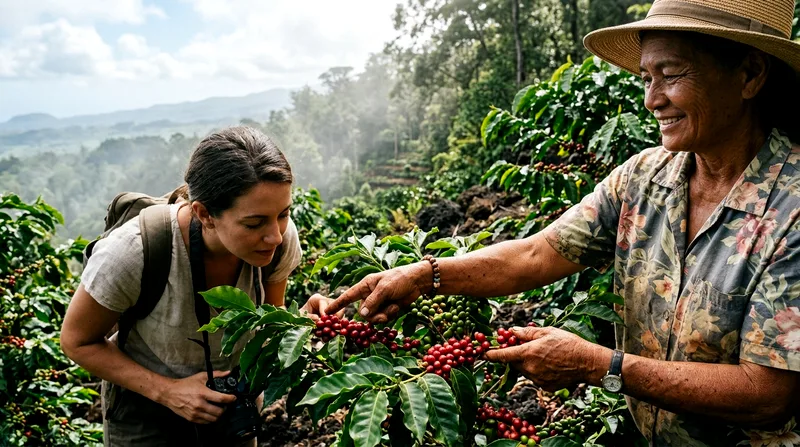
A free kona coffee farm tour typically covers the basics: what a coffee cherry looks like on the tree, roughly how altitude and volcanic soil affect flavor, and a quick look at hulling or sorting equipment if it's running that day. You'll get a tasting of two to four roast levels, usually from light to dark, poured at a counter rather than brewed to order. What you won't get is deep detail on fermentation times, water usage, or the economics of why 100% Kona coffee commands a premium over blends labeled "Kona blend" (which can be as little as 10% actual Kona beans — a labeling quirk worth knowing before you buy). These tours run without reservations in most cases, which makes them easy to slot into a driving day along Highway 11.
What paid in-depth tours add
Paid tours add structure: a scheduled start time, a smaller group size, and usually a guide who stays with you through the whole process rather than pointing you toward a self-guided loop. Expect more time in the field among the trees, a stop at drying patios or raised screens, and often a cupping-style tasting where you compare beans processed differently from the same harvest. The Kona Coffee Living History Farm is the clearest example of paid-tier depth, even though some of its programming is donation-based rather than a fixed ticket price — check current fees directly with the farm, since this varies by season and event. The honest downside of paid tours is pacing; they run long enough (often 60 to 90 minutes) that young kids and tight itineraries don't mix well with them.
Kona Coffee Tour Types Compared
Grouping the Kona coffee belt's visitor options into four categories makes the decision easier: free tasting rooms, guided working-farm tours, the living history farm, and combination tours that pair coffee with another local product.
Free tasting rooms are quick and casual, while the living history farm and guided paid tours go deeper into the actual bean-to-cup process.
Kona coffee farm tour types compared by process depth, tasting and duration
| Tour Type | Process Coverage | Tasting Included | Typical Duration | Reservations | Accessibility |
|---|---|---|---|---|---|
| Free tasting room (e.g. Greenwell Farms, Heavenly Hawaiian) | Basic overview | Yes, 2-4 roasts | 20-45 min | Walk-in | Generally good, paved areas |
| Guided working-farm tour | Moderate to detailed | Yes, often included | 45-60 min | Recommended | Some uneven ground |
| Kona Coffee Living History Farm | Full historical process | Sometimes, seasonal | 60-90 min | Recommended | Sloped, limited for wheelchairs |
| Combination tour (coffee + cacao, e.g. Hale Cocoa) | Coffee basic, cacao detailed | Yes, both crops | 90-120 min total | Required at most stops | Varies by farm |
Durations and inclusions vary by farm and season; always confirm current details before visiting.
Bean-to-cup process coverage by tour type
Free tasting rooms generally show you the finished product and maybe a piece of processing equipment behind glass. Guided working-farm tours, like those at Greenwell Farms, walk you from tree to drying deck to roaster, though on a working farm you may not see every stage happening live depending on the season. The living history farm is the only stop that reliably demonstrates the full historical process — hand-pulping, sun-drying on patios, hand-sorting — because that's its entire purpose as a museum rather than a commercial operation. If seeing the complete bean-to-cup arc matters to you more than anything else, the living history farm beats every working farm tour on thoroughness, even though it skips modern roasting technology.
Combination tours with chocolate or other stops
Some visitors prefer to combine coffee with Hawaii's small but growing cacao scene — Hale Cocoa, also on the Big Island, runs its own farm and chocolate-making demonstrations and pairs naturally with a coffee stop since both crops grow in similar upland microclimates. A half-day combining a free coffee tasting with a cacao farm visit works well for couples and families who want variety without committing to two long, separate bookings. The trade-off is logistics: cacao and coffee farms aren't always close together, so check drive times between stops before assuming you can do both comfortably in an afternoon. Compare this to pairing a Maui road trip stop with a lavender farm — same idea, different crop, and it only works if the stops are genuinely on the way.
What to Look for When Booking
Before you lock in a kona coffee farm tour reservation, check a few practical details that matter more than the marketing photos. Group size affects how much individual attention you get from the guide — a tour capped at 10 to 15 people feels very different from one run alongside a full tour bus. Ask whether the tasting happens before or after the walk; farms that taste first sometimes lose you to the gift shop before the educational portion even starts.
Inclusions, group size and cancellation
Confirm exactly what's included: some paid tours bundle a bag of beans or a branded mug into the price, others charge separately for retail. Cancellation policies on the Big Island tend to be lenient for weather but stricter for simple no-shows, so if you're juggling a packed itinerary that also includes a snorkel trip or a sunset sail, book the coffee tour for a flexible time slot rather than squeezing it between two fixed bookings. Group size caps aren't always published online — when in doubt, call the farm directly rather than relying on a generic listing.
Parking and transport from resort areas
If you're staying at the Outrigger Kona Resort and Spa or elsewhere in Kailua-Kona, most coffee farms sit 15 to 30 minutes south along Highway 11, which makes a rental car the easiest way to go. Parking is free and plentiful at the bigger tasting rooms; it's tighter and sometimes gravel-lot only at smaller working farms, so low-clearance rental sedans are fine but don't expect paved lots everywhere. There's no real public transit option for this route, and ride-share coverage thins out once you're off the main highway — factor that into your plan if you don't have your own car.
When to Book and Visit
Kona coffee farms operate year-round, but the experience shifts noticeably depending on when you show up.
Harvest season versus year-round visits
Harvest typically runs from roughly August through January, with peak picking activity often in September and October. Visit then and you're more likely to see actual cherry-picking, sorting, and pulping in progress rather than static equipment. Visit in spring or early summer and you'll see flowering trees — genuinely pretty, with a strong jasmine-like scent — but less hands-on processing to watch. Neither season is wrong, but if seeing real work in progress is the point of your visit, don't book a March trip expecting an active harvest floor.
Walk-in versus reserved tours
Free tasting rooms almost always accept walk-ins, which suits travelers who prefer a loose, unscheduled driving day along the coffee belt. Paid and educational tours, including the living history farm, benefit from reservations, especially during peak winter travel months (December through February) when Big Island visitor numbers climb. If your trip dates are fixed and this stop matters to you, reserve ahead; if you're flexible and just driving through, walk-in tasting rooms will always have something open.
Frequently asked questions
Is there a free tour of a Kona coffee farm?
Yes. Several working farms, including Greenwell Farms and Heavenly Hawaiian, offer free walk-through tours and tastings without a reservation. These are lighter on process detail than paid tours but are a solid option if you just want a quick, no-cost introduction to Kona coffee.
Do Kona coffee farm tours include tastings?
Most do. Free tasting rooms typically pour two to four roast levels at a counter. Paid and guided tours usually include a tasting too, sometimes structured as a side-by-side comparison of different processing methods, but always confirm it's included before you book, since policies vary by farm and season.
Are reservations required for Kona coffee tours?
It depends on the type. Free tasting rooms generally accept walk-ins. Paid working-farm tours and the Kona Coffee Living History Farm recommend or require reservations, particularly during harvest season (roughly August to January) and peak winter travel months.
How long do Kona coffee farm tours last?
Free tasting room visits usually run 20 to 45 minutes. Guided paid tours typically last 45 to 60 minutes, and the Kona Coffee Living History Farm's full experience can run 60 to 90 minutes given its larger grounds and historical demonstrations.
Is a paid Kona coffee farm tour worth it?
For casual visitors, not necessarily — free tasting rooms cover the basics fine. For anyone who wants to understand fermentation, drying, and roasting in real depth, yes: paid tours and the living history farm show far more of the actual bean-to-cup process than a tasting counter ever will.