Compare group, semi-private and private surf lessons in Waikiki for first-timers, kids and older beginners, and see what each lesson price really includes.
Best Surf Lessons in Waikiki for Beginners
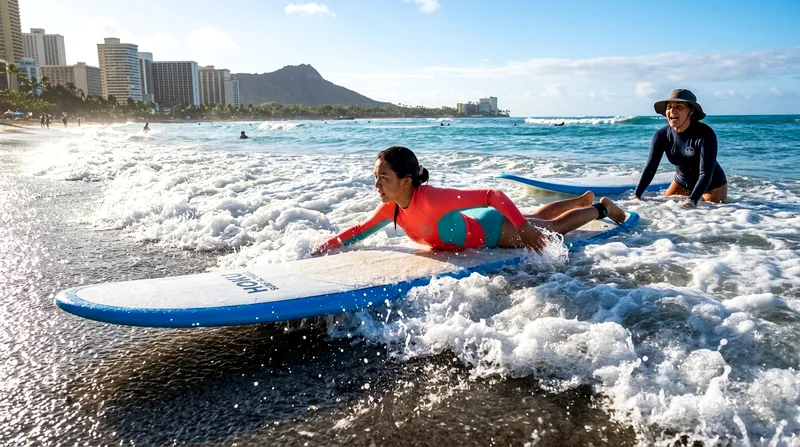
There's a reason Waikiki shows up on nearly every "learn to surf" list for Oahu: the waves here break slowly, roll a long way, and give a first-timer several seconds to find their feet instead of getting pitched over the falls. Standing up on your first try isn't a fantasy at Waikiki — it's the realistic outcome for most beginners, assuming you pick a lesson format that actually matches how you learn.
That's the part people get wrong. They book whatever shows up first on a search, usually a group lesson, without considering that a nervous swimmer, a hyperactive eight-year-old, and a reasonably fit 45-year-old who just wants to say they surfed in Hawaii all need different levels of attention. Surf lessons in Waikiki generally come in three formats — group, semi-private, and private — and each one trades off cost against coaching time and water space. Get the format right first. Worry about which school second.
Which Surf Lesson Suits Which Beginner
Not every beginner needs the same thing from an instructor. A confident swimmer in decent shape can often progress fine in a group of four to six, picking up cues from watching others get corrected. Someone who's anxious in open water, has a bad knee, or simply hates being watched will do better — have more fun — with more one-on-one attention, even if it costs more.
Age and fitness matter just as much as confidence. Most Waikiki surf schools set a soft minimum age of 5 to 7 for kids, and some cap group lessons at 6 or 8 participants for safety reasons. Older beginners, say 55 and up, sometimes assume they need a private lesson purely because of age — that's not always true. If you swim regularly and have reasonable shoulder mobility, a semi-private lesson often works fine and costs noticeably less.
First-timers and nervous swimmers
If you've never stood on a board and you're uneasy in the ocean, skip the big group class. A private or semi-private lesson gives the instructor time to walk you through paddling, timing, and the pop-up on the sand before you're anywhere near a wave — and crucially, they'll be right next to you in the water, often holding the board steady as the wave arrives. In a group of six, that hand-holding simply isn't possible; you get one demonstration and then you're on your own. Waikiki's whitewash waves near the Kuhio Beach break are forgiving, but forgiving isn't the same as effortless, and nervous swimmers do better with direct supervision.
Kids, families and older beginners
Surf lessons for kids in Hawaii work best in small groups or as a private family lesson where a parent paddles out alongside the child. Most schools allow kids as young as 5 in a private setting but prefer 8 or older for group classes, since younger children struggle to keep up with group pacing and instructions shouted over wave noise. For a family of four, a semi-private or private family lesson often ends up similar in per-person cost to booking four spots in a group class, while getting everyone far more individual coaching — worth checking both options before you book rather than assuming group is cheaper.
Group, Semi-Private and Private Lessons Compared
The three formats aren't just about price — they differ in group size, how much individual correction you get, and how much actual wave-riding time is packed into the lesson. A 90-minute group lesson might only translate to 8-10 real wave attempts per student once you account for paddling out, waiting for turns, and instructor demonstrations. A private lesson of the same length can easily double that, because the instructor positions you for every set and pushes you into waves rather than letting you find them yourself.
Semi-private — usually 2 to 4 people, often friends, couples, or a parent and child — sits in the middle. You share the instructor's attention, but with a quarter of the people a standard group class has, so wait times between waves shrink considerably.
Private lessons cost more but roughly double the wave attempts you get compared to a standard group class.
Waikiki surf lesson formats compared: group size, pace and best fit for beginners
| Lesson Format | Typical Group Size | Price Tier | Coaching Level | Best For |
|---|---|---|---|---|
| Group | 4-8 students | Budget | Shared, limited correction | Confident swimmers, solo travelers, teens |
| Semi-private | 2-4 students | Mid-range | Moderate, shared attention | Couples, friends, fit older beginners |
| Private | 1 student (or 1 family) | Premium | Full, one-on-one | Nervous swimmers, young kids, seniors |
| Private family lesson | 2-4 (same family) | Premium | Full, split between members | Parents surfing with kids |
Price tiers are relative, not fixed figures — always check current rates and inclusions directly with the surf school before booking.
Comparison table: format, group size, pace and best for
Use the table below as a starting point, then check the specifics with whichever surf school you're considering — schools like Ohana Surf Project, Kahu Surfing School, Waikiki Surfing School, and Star Beach Boys all run some version of these three formats, and small details (max group size, board type, meeting point) vary.
Lesson length and how much surfing time you get
Most Waikiki lessons run 90 minutes to 2 hours total, but that figure is misleading if you don't break it down. Expect roughly 20-30 minutes of beach instruction — pop-up drills, paddling technique, safety briefing — before you ever touch the water. That leaves about an hour of actual water time in a standard lesson. In a group class, you'll spend a good chunk of that hour waiting in line behind other students; in a private lesson, nearly the whole hour is yours. If getting the maximum number of waves ridden matters more to you than cost, that's the single biggest argument for upgrading from group to semi-private or private.
What Your Lesson Price Really Includes
The headline price rarely tells the whole story. Most Waikiki surf schools bundle board rental and instruction into one fee, but what counts as "included" varies enough that it's worth asking directly before you hand over a credit card.
Boards, rash guards and instruction
Nearly every beginner lesson uses soft-top longboards — typically 9 to 11 feet — because they're stable, buoyant, and far less likely to injure anyone on a crowded beach than a hard fiberglass board. That board rental is almost always built into the lesson price. Rash guards are usually included too, partly for sun protection and partly so instructors can spot their own students in the water. Instruction itself is the beach briefing plus in-water coaching described earlier; ask whether the quoted time is total lesson length or water time only, since schools define this differently.
Common extras: photos, parking and transport
Photos and video of your lesson are frequently offered as a paid add-on rather than included — worth deciding in advance if that matters to you, since asking mid-lesson is awkward. Parking near Waikiki Beach is scarce and metered street parking fills early; a few schools offer validated parking at a nearby garage, but don't assume it's free. If you're not staying within walking distance, factor in a rideshare or the TheBus, since very few lessons include hotel transport. Some Waikiki operators listed on platforms like Hawaii Activities or reviewed on TripAdvisor note these extras in the fine print — read past the headline price before comparing two lessons that look similar.
What to Look for When Booking
Price and format aside, a few practical details separate a good lesson from a frustrating one, and most of them are things you can verify before you pay anything.
Instructor qualifications and safety
Look for instructors certified in CPR and basic water rescue — reputable Waikiki schools train staff in ocean safety given how crowded the lineup gets with swimmers, canoes, and other surf schools sharing the same stretch of water. A good instructor-to-student ratio matters more than any certificate: for group lessons, one instructor per 4-6 students is reasonable; beyond that, you're paying for a lesson but getting a loosely supervised rental session. It's fair to ask directly how many students one instructor handles in the water, not just on the beach.
Cancellation, weather and rescheduling policies
Waikiki's surf is seasonally variable, and schools occasionally cancel or shorten lessons when conditions turn choppy or a high-surf advisory is posted. Check the cancellation window — many allow free rescheduling up to 24 hours out, but same-day cancellations by the customer are often non-refundable. Weather-related cancellations initiated by the school should come with a full refund or reschedule option; if a school's policy doesn't clearly state what happens when they cancel, that's a yellow flag worth asking about directly before booking.
When to Book Your Waikiki Surf Lesson
Booking timing affects both availability and water quality more than most first-timers expect. Lessons in Waikiki run year-round, which is part of its appeal over somewhere like Bali's Kuta Beach or Oahu's own North Shore, where winter swell gets too big and fast for beginners entirely.
Seasons, swell and best time of day
Summer months, roughly May through September, tend to bring smaller, more consistent waves to Waikiki, which suits total beginners. Winter can still work for lessons here specifically — Waikiki's south-facing beaches are sheltered from the big north swells that hit elsewhere on Oahu — but afternoon winds can get choppy, so morning lessons, generally before 10am, tend to have cleaner, calmer conditions. Weekday mornings also mean fewer people sharing the lineup; weekend lessons can feel crowded with multiple schools running classes on the same stretch of sand simultaneously. If you're booking during peak travel weeks around the winter holidays or mid-summer, reserve at least a few days ahead, since popular time slots fill first.
Choosing the Right Lesson Format
Decide on format before you decide on a school. Confident swimmers and solo travelers comfortable learning alongside strangers get solid value from a group lesson. Couples, friends, and fit older beginners usually land best in semi-private, where cost stays reasonable but wait times drop. Nervous swimmers, young kids, and anyone wanting maximum wave count per dollar should lean private, even though it costs more per person.
Once you know which format fits, compare current prices, cancellation policies, and reviews across a few Waikiki schools — including the ones mentioned here — before booking. Conditions, instructor ratios, and what's included can shift, so check live availability and current terms directly with the school rather than relying on last season's pricing.
Frequently asked questions
How much does a surf lesson cost in Waikiki?
Prices vary by format rather than by school. Group lessons sit at the budget end, semi-private costs noticeably more per person but less than solo coaching, and private lessons sit at the premium tier. Exact figures shift with season and demand, so check current pricing directly with the school before booking rather than relying on older estimates.
What is included in a Waikiki surf lesson?
Most lessons bundle soft-top board rental, a rash guard, beach instruction on pop-ups and safety, and in-water coaching. Photos, video, and parking validation are usually separate add-ons rather than automatic inclusions — confirm this before paying, since it affects how the total price compares across schools.
Are there surf lessons for kids in Waikiki?
Yes. Most schools accept kids from around age 5-7 in private or family lessons, with a slightly higher minimum, often 8, for standard group classes. A private family lesson lets a parent and child share one instructor, which usually works better than putting a young child into a group with adults.
What is the difference between group and private surf lessons?
Group lessons put 4-8 students with one instructor, meaning more waiting and less individual correction. Private lessons give one student (or one family) full attention for the entire session, roughly doubling actual wave attempts compared to a group class of the same length.
Do I need experience to take a surf lesson in Waikiki?
No — Waikiki's gentle, slow-breaking waves are specifically why it's considered one of the best beginner surf spots anywhere, comparable in forgiveness to learning breaks in Costa Rica or Bali but with calmer, more consistent conditions. Basic swimming ability and reasonable fitness are the only real requirements for a standard beginner lesson.